Monday, April 25, 2011

Turtlehead Island, Part 3


--3-8 April 2011--


Left:  Pinctata maxima with natural blisters and Torres Pearls silver-gray pendant

Ok, so where were we?!  I suppose I ought to kick this blog off with an apology for my virtual disappearance act.  Time flies, etc…that’s all I have to say about that.  Rather than listing even one reasonable or imagined excuse, I’d rather jump right in and get on with the recapping of my awesome April.  I’ll do this in a few posts so this won’t be painfully long, but realize now that I’m starting where I left off, 3 weeks ago, way up in the Torres Strait….

Above: CB keeps vigilant watch for crocs and dolphins; After observing how much Rusty loves to catch fish, CB took it upon himself to catch us some dinner!  Unfortunately his fish wasn't what we had in mind....but he was SOOO pleased with his guitarfish.


Mostly I just want to share my fun photos from the last part of my wonderful stay at Torres Pearl farm.  Back in February I had tried to use Everytrail.com as my main photo-sharing tool, but the website is just too darn slow, and it sucked up all my $5/hr internet time, ouch!  So this bloggy-wog is about to get heaps more photographic.  Prepare yourself. ;) 


Above:  Bronwyn (dripping with Torres Pearls) and me at Turtlehead Island.  Below:  Now that's my idea of decoration!  Years of desceased pearl shells decorate the campus, framed in their own culture baskets; My island house is surrounded and perfumed by these native Frangipani (Plumeria) flowers!  Ah, I love the tropics!


 Above:  Just before sunset, we got a treat of a full double rainbow that stretched right across the river mouth and over the mangroves.  I was too close to even get the whole arc in one shot!; With a full, double rainbow to the East and an imaculate sunset to the West (below), which way would you stare??

The last bunch of days I spent at Turtlehead Island were filled with more great food and company, and some rush to get Rusty’s fantastical no-plan working raft near completion.  Getting things done on a remote tropical island, especially working on the water itself, takes so much more work than imaginable.  There’s the planning for tides, rain, winds and waves, and then there’s got to be meals and smoko (snack time) fitted into the day, and of course sunset-break time.  A couple of days we got so far as to carry wood plancks to the wharf before running for shelter to play scrabble and uno.  I’m sure that by the time I’m writing this, that magnificent raft is complete and upriver, ready to support heaps of pearl farm labor.  However, by the time it was time for me to depart back to the mainland, we had assembled only a portion of what would become an impressive roof and walls.  Not much marine science knowledge necessary for these tasks, but now I do feel quite confident that if I ever become stranded on a deserted island, I could and would make a survival raft which would make Bear Grylls darn proud!...not to mention rafts of more entertaining value, if the occasion called…


Above:  Grotty approves of our work so far on the pearling raft, once it's proven river-worthy.    

Right:  It has grown substantialy since last week,  but we've got heaps more work to do!  This ain't no simple leisure raft!  This is a serious working vessel!


When the afternoon heat and the low tide found a happy arrangement, Bronwyn and I took to walking the beach and mangroves to find amazing treasures; or, at least, entertaining animals and artifacts, including corals, seashells, flotsam from crashed planes, boats and autos.


Above: This lucky anemone just had a nice mud-crab lunch!  I'm jealous of it's good taste in prey, but am also amazed at this beautiful, plate-like mouth, covered with purple and green shag-carpet-like tentacles.  Brilliant!

 Below:  Hmm, now I'm thinking maybe this anemone is an upside-down jelly?  I still haven't been able to find this "bushy" anemone in an ID book yet...and ideas from my Cnidarian-ologists? 


Below:  No, it's not plastic mesh, it's the remains of a spectacular soft coral (I think...if anybody can identify this 2 ft-wide basket-like skeleton, I'd be much obliged); Upclose image of what I'm provisionally calling a "basket coral" skeleton.   


Below:  Basket ferns form the border between the mangrove thicket and the proper rainforest.; One brave lone mangrove sapling dares to take on the tides way out on the beach.  A tenacious tree!

When it was time to pack up and head back to “civilization” (although I felt much more civil way out here than in any of the mainland cities, esp. Cairns, where I often felt quite uncivil toward tour hawkers at times!), I got the treat of a second leisurely boat ride back up the Middle and Jacky Jacky Rivers to Bamaga, dodging rainclouds through the pristine mangrove wilderness.  Did OPRAH get a private tour through THIS magnificent countryside, with her own personal driver?  I think I win!  We didn’t spot any crocs on this ride, but since the tide was so much higher, we whizzed through the narrow channels.  Check out the video at the end!

More fantastical sunsets over the Cape York Peninsula from the wharf.   


 Below:  Biology and Physics create a beautiful landscape:  soldier crab sand-balls gather between the sandy ripples at the beach.


Right:  The Bamaga airport.  Note the lack of airplane and other living souls.  Cue Casablanca music.

Because of the tides, I arrived at the “airport” a good 2 hours before the other 15 passengers (and the airplane).  Ever seen one of those black-and-white movie scenes with the tiny train station out in the sticks, in the pouring rain, deserted except for the one pitiful individual who’s got nothing better to do?  Well that wouldn’t be far off from the reality (except that I know how to fall asleep practically anywhere, thus solving my entertainment wants).  And then, as if on cue, a man walked in out of the rain.  Was he dangerous?  Was he a handsome cinematic hero (going with the black’n’white drama, here, bear with me).  It was destiny, indeed.  But alas, no.  He was neither of those exciting plot options.  He was, in fact, a SkyTrans corporate exec  from Cairns, who took pitty on the fact that I had all the appearances of a desolate, possibly homeless backpacker, with my sweaty work clothes and my inappropriate use of the small wooden bench as a siesta nook.  With all the gallantry such an occasion could allow, he smiled and handed me nothing less than a SkyTrans baseball cap, pulled elegantly from a big plastic sack.  Ok, you probably thought this was leading up to something important, but you KNOW how much I LOVE free stuff!!  It is my most beloved baseball cap, ever. ;)

Zooming through the mangrove wilds of Cape York Peninsula's Middle and Jacky Jacky Rivers towards Bamaga from Turtleahead Island


Friday, April 1, 2011

Turtlehead Island, Part II

 Saturday, 2 April 2011 – Turtlehead Island, Torres Strait, QLD


Since Monday, my days have settled into a precise schedule here on Turtlehead Island.  Working at the Pearl Farm, as I expected, is not glamorous and is tough but interesting work!  Rusty, who used to be a pearl dealer on Thursday Island, took over the Escape Island pearl farm only two years ago.  The farm had basically been run into the ground (mud, actually) by a set of international investors, and the island had gone from the historically renowned Pink Pearl capital to an unruly quagmire of drunken workers and filthy work conditions.  In just a short time, the troublemakers were rooted out, the campus beautified, and the reputation built back up as a productive, high standard, environmentally conscious business.  Things are looking up, but it took a lot of work, and there’s still heaps of projects left to be done, to get the farm back to its well-oiled-machine-like glory.

Left:  when the generator is turned off at night, my house lamp makes a frightening impression in the ultra-black night!  Above:  Nautilus pompilius shells wash up on the beach in the dozens, sometimes traveling clear across the GBR.  I lucked out with this fresh one!

This month is the season for farm maintenance, with at least 2 months to go before the pearls are harvested and re-seeded with nuclei (FYI, all cultured pearls start out as “nuclei,” which are beads of cut from the Mississippi Mussel shell inserted into the pearl oyster gut along with a tissue graft; so, the core of your $100,000 pearl is just an ugly glob of mud-clam calcite, hehe).  That means that there are infinite projects to be done around the island, so most of the work I’ve been doing involves the organic veggie garden and getting some of the dilapidated equipment cleaned and functioning properly (the previous owners obviously had no clue how to care for, or even use, their own microscopes and x-ray machines!).

 
Our afternoon project over the last few days has been to build a gigantic work-station raft to be anchored up river so that the pearl shells don’t have to be hauled back and forth for each harvest.  We spent a whole day collecting all the materials, scavenged from either the beach flotsam (that’s some serious beachcombing!) or from one of the disassembled buildings on campus, and the next 3 days putting together the floating frame of plastic barrels and wood poles.  Today we floated the huge frame out to the water and she’s seaworthy!  The tides, climate, and island fauna mean that we only have a few hours in the afternoon to get all this work done:  crocodiles patrol the mud banks near high and mid tide, so we wait until we have ample space between us and the waterline before hitting the beach; the tropical midday sun paired with the 90% humidity (or just 100% rain) turns the slightest work into a substantial effort; and the heat and rain makes the insect repellant drip off so that any exposed skin is instantly attacked by mozzies and sand flies.  How on earth does anything get done around here??!!  I’m not complaining—I mean, half of the day is too hot and/or wet to do much work, then when the weather calms down it’s just sssoooo niiiiice that all you want to do is sit on the dock and watch the birds/dolphins or take the dogs for a walk on the beach to pick up cool junk and seashells!!


Above:  the first section of our mega-raft after day 1.  She floats!  But in a few days she'll have a workstation on her and will be croc- and yachtie-proof!  Below: CB (Croc Bait) poses to show how gigantic this Syrinx shell is...but CB is a gigantic dog.....I guess next time I'll put a normal-sized object in there, too, haha!!

But we managed to get the raft together and now it’s time to turn it into a habitable platform, complete with hut and workbench!  My job will be to paint a BIG sign to warn yacht-goers that the platform is NOT a picnic spot for their personal enjoyment!  I’m thinking something like: “Private Property: Beware of Guard Crocs”.  This island is incredibly remote, but the mouth of the Escape River is a renowned fishing spot and is the only safe inlet on this coast for yachts to anchor overnight.  So far, I’ve only seen one tiny fishing boat pass by; otherwise, this coast is our kingdom! 

After each day of “intense labor”, we sit and watch the sunset and fish off the dock, or take the boat out around the island to the Coral Sea, or to check on the pearl floats.  Besides fishing, at which I have no talent, skill, or luck (so far I’ve cast over 50 times and have hooked 2 submerged ropes and have netted one large mud crab), there’s lots of entertainment to be had with the dogs, Gottie and CB (Croc Bait), who are always willing to help crack/chew open coconuts or act as croc-sentry on walks along the beach!

I hope you all are having a wonderful April (well, the 2 days of it so far) and continue to stay happy and healthy!  Over and out until next time (which may not be for a while....internet is seriously patchy here when we're always covered by rainclouds!)

Cheers!

Torres Strait: Turtlehead Island, Part I

28 March 2011 – Turtlehead Island, Torres Strait, QLD (backlogged entry)
Well, three days have already gone by since I arrived here at the Torres Pearl Farm, and I’ve been having a blast!  I had spent Friday afternoon in Cairns (pronounced “Cans”), walking and window shopping (there’s not much else to do, it seems).  My 20-hour impression of Cairns was that of a city filled with tour offices, expensive seaside cafes, and shopping, shopping, shopping (high-end as well as kitsch).  The city is basically plastered with neon brochures advertising cruises, sailing charters, and SCUBA dive opportunities, and I wasn’t in town 20 minutes before my bag was filled with pamphlets recommended by tour offices.  Ahg!  Stay away from my wallet!!  Luckily my dose of Cairns was small—I spent one night on the outskirts of town then caught my flight out the next morning (Saturday the 26th).  I’ll return to Cairns in 2 weeks, so I have some time to decide whether or not to do much diving from that city, or just move on to other “Gateways” to the GBR.
Left:  Departing Cairns to head north to Cape York Peninsula, of COURSE the flight had to take a long arch over the GBR as part of the not-so-straight-shot route to the Torres Strait!  Right:  First glimpse of the GBR, inner reefs!
~~ ~~ ~~
I’m not sure when I had decided that Torres Strait was on my Australia Must-See list.  I think there’s a particular fascination up here (for me) because the Far-Far North Queensland is one of the last great frontiers in Australia: a truly wild region where there are certainly way more crocodiles that people and being so tropical and close to Papua New Guinea it has a totally different vibe and culture than the rest of Australia.  It’s hardly mentioned in any tourist source:  some books state outright that there’s nothin’ to see up here, others spin the unsealed “highway” as a challenge to hard-core 4WD trailblazers, but without any particular destination.  I had read that the top of the cape had always been a sort of No-Man’s-Land between the Pacific Islanders and the Aboriginal mainlanders because the warlike Islanders used to hunt dugongs, turtles, and peaceful Aboriginal people for dinner (cannibals).  The land up here is almost exclusively Mangrove forest, with meandering rivers and creeks looping between the Coral Sea to the East and the  Gulf of Carpenteria to the West, and is ruled by crocs, dugongs, river dolphins, gigantic barramundi fishes, and the less brawny shorebirds. 

Jelly-bean and Cuttlebone shaped coral/sand cays in the northern part of the GBR.  Left: Oz's #1 drift dive spot, Bligh's Boat Entrance, at top of pic.  Right:  western cays part of the Great Detached Reef (Tijou Reefs?)

Whatever was the initial draw, flying up to Bamaga on Saturday—with the purpose of living and working on a small pearl farm—was perhaps the most giddy I have felt since arriving in Australia.  There’s only one flight to Bamaga every day, from Cairns.  Want to get there from Sydney?  Too bad.  From Darwin?  Not a chance.  Regardless, I officially recommend to anybody traveling in Oz to just take any flight along the Northern Queensland coast.  For the same price as a 2-hour Great Barrier Reef flight, I paid for a round trip ticket up to Horn Island and back.  While we didn’t fly in circles around the reef, we were in such a small plane that we cruised right over the ribbon reefs, and coral islands that make up the northern half of the GBR for 2 hours, WITH lunch! ;)

Left: flying over the Jackey Jackey River to land in Bamaga.  At the top of the pic is the mouth to the Coral Sea, with the last creek on the right leading south to the Escape River.  Right:  with the boat full of fuel and supplies, we arrive at Turtlehead Island, in the mouth of the Escape River, my home for the next 2 weeks!  Below: colorfully painted Torres Pearl Farm campus, my house is the little blue one. :)

When I landed in Bamaga, Rusty picked me up and we headed down the stream between mud banks and encroaching mangroves.  My arrival had coincided with Rusty’s bi-weekly trip into “town” for supplies, so we were loaded down with jugs of fuel, food, and goodies, just barely buoyant enough to squeeze through the nearly empty low-tide creeks.  Not 5 minutes down the stream from the boat ramp, Rusty turns and says very seriously “This is an ‘All-Hands-In-The-Boat’ kind of stream”.  It wasn’t more than a couple minutes later that we spotted the first crocodile (about a 9-footer) slide into the river just a couple meters in front of the boat!  The ironic part of it was that we had been cruising for another 20 minutes before Rusty announced that NOW we were in the WILDERNESS, and we still had a ways to go!!  Where exactly had we been previously?!  It all looked pretty wild to me.  Bamaga is the only accessible town up here, with just the basic necessities—airport, post office, mechanic, grocery.  No bank nor pharmacy:  just the necessities, for sure!  But there are a few small homes and fishing docks hidden among the mangroves for a few miles before the waterways are completely untouched.

 
Above:  Turtlehead Island's Front Beach, on the Coral Sea.  Bronwyn and I beachcombed for cool flotsam and seashells (like this coral-encrusted runner) while Rusty went fishing for dinner.  Below:  The dogs love Front Beach because it is the only wide open expanse that's croc-free at low tide.

It poured down buckets all night, then all yesterday morning, then most of the afternoon. Relentless rain that streamed under the buildings and overflowed the water tanks, and turned the water the color of strong coffee.  The clouds never parted, but the rain let up for a few hours, so we loaded the dogs into the boat and coasted around the island to the Coral Sea.  Rusty let us ladies out with the dogs while he went off to fish for dinner.  I know fishing sounds more exciting than walking on a flooded, soggy beach, but let me tell you, this one was a beachcomber’s dream.  The storms had brought in not only heaps of nautilus shells, but also tons of ocean plastics—everything from salvageable stuff like buoys and rope to bottles and baby toys to the icky small fragments and nertles.  One gets mixed feelings about all this human debris on the beaches, because while it’s testament to how irresponsible people are about caring for the oceans, it is also lots of fun to imagine all the sorts lives these items had before ending up on this particular beach.  For example, what has this lone shoe been up to that it is now covered in coral heads?  Or, isn’t anybody missing this important-looking safety helmet or line of barrel buoy?  And how many thousands of people are out there walking around with one flip-flop?!  Tomorrow most of this beach junk will have moved on and will be replaced by a whole new set of stuff.


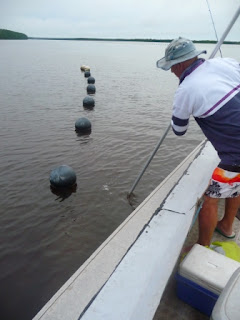
Above:  rusty fishes down to pull up one of the pearl shell, Pinctata maxima, baskets growing the rare pink pearls.  Below:  matrix of buoys and pearl shell baskets.  It looks like a lot of floats, but the whole farm takes up only a tiny fraction of the waterways.  Heaps of space for dolphins and the rare boat traffic.

This morning I helped Bronwyn clean a bunch of young Penguin Oysters, which recruit to the Pearl Oyster (Pinctata maxima) baskets and are raised for growing small half-pearls.  Then we all went out to check on some of the Pink Pearl oyster baskets up the river.  Years and years before Rusty and Bron took over the farm, the Escape river had been famously known as one of the few sources of pink pearls—traditional pearls are white, and there’s also oysters that produce black, gold, silver, and gray pearls.  Perfect pink pearls are particularly rare and nobody seems to know (at least, in the industry) what exactly makes them pink.  I guess that’s
why they wanted me up here...yay, science!


Penguin shells, for growing Mabe Pearls

This evening we sat on the dock for sunset and watched a lone snub-nosed river dolphin feed not 10 meters from our feet, while Rusty tried some fishing, aided by CB, who gave a valiant effort at NOT barking at the dolphin and the fish (he’s trained to bark at boats and crocodiles).  And now it’s lights out for me and the rest of the island—the power (diesel generator) is switched on only 6-8 hours per day here—so I guess this is good night!

Above:  Snub-nosed Dolphin cruising for fish near the pearl farm buoys and dock.  Below:  CB stands as croc-sentry while Rusty fishes and Bron and I watch the dolphin


Seriously...What day is it?  And does it matter, when the sunset is really the important part of the day?! :)


We motored across waterways large and small, none of which had markers or much of a landmarks on the banks (making long-distance navigation an impressive skill!) and reached Turtlehead Island about 1.5 hrs later, without seeing a single other vessel, but plenty of crocs.  I’m still working on my “Croc-or-Rock?” search image, but I saw enough to feel completely surrounded. ;)  Bronwyn and the two dogs, Grottie and CB (Croc Bait), greeted us on the docks and I got a warm welcome to the happy island.  That night we sat around chatting, fishing for barramundi off the docks, playing with the dogs, and generally having a wonderful evening.  Then it began to rain….

Friday, March 25, 2011

Leongatha Star News Piece

Leongatha Star, 22 March 2011

I made the news!  Here's a bit that I worked on when I was in South Gippsland, to help out with the conservation of the Venus Bay beaches:

Down Under at The Top End!

25 March 2011 – Darwin, NT

Wow, did that week fly by!  It feels like I arrived in Darwin only yesterday and I’m already being whisked away by my own stubborn travel schedule. ;) I could easily stay here for another …year or so (which, I realized, is what happens to many travelers who come here!  I was told that I was wise to book my ticket out before I arrived….something magnetic about this place).  Well, here’s the tale of my trip to the Top End, already halfway around the continent from where I began!

On Saturday I found myself unexpectedly flying towards Alice Springs: a state of surprise altogether unexceptional, considering that it was just the most recent of unexpected events and happy accidents which I had been enjoying over the last couple of days.

I was somewhat reluctant to depart Coral Bay—after having such easy times and hanging out with lots of super people—and it seemed that the Greyhound bus was just as reluctant to pick me up.  Three hours after I had a farewell dinner…then desert…then drinks with Coral Bay friends, I was still waiting on the bus to come and sweep me away on my next adventure.  Some mysterious event had occurred somewhere along the 18-hour route from Perth that resulted in a bus rolling up to the backpackers at 1:45 am, completely empty and without apology.  Would YOU get on that bus?  I was too tired to ask questions, and desperate to get up to Karratha.  Nobody SHOULD be desperate to get to Karratha, by the way.  
 In planning my route from Exmouth to Darwin, I had believed that I had got my transfers perfectly scheduled, with a nice 3-hour window to arrive in the mining town of Karratha and catch my flight to Darwin.  With a 3-hour-late bus, I was a tiny bit worried (and I never worry, right? Haha).  It turned out that the late bus actually SAVED me from having to spend more than 30 minutes in Karratha.  This town was the pits, the only good thing about it was cheap airfare, which catered to the REASON that the town was the pits.  Karratha and its sister-town, Tom Price, are one of Western Australia’s fastest-growing mining towns.  The whole district is owned and run by big mining companies—from apartments to grocery stores to schools—even the taxi I rode in was owned by the mining corporation (much to the chagrin of the driver).  It was a very happy accident, therefore, that the bus dumped me at Mc Donalds at 8am, so that by 8:40am I was safely on board my plane bound for… …Alice Springs??!!
 
It hadn’t occurred to me that a flight from Karratha to Darwin should take 7 hours, but who was I to judge Australian distances?  Nowhere in the airport or on my Qantas ticket did the words Alice Springs appear, so I had assumed that the day’s surprises were done.  Haha, silly Heather...  When the flight attendant gave instructions that “All passengers should exit the aircraft in Alice Springs” I first got a jolt of anxiety—OMG, was I on the right plane?!—but then I felt like I had won some sort of Fabulous Prize!  I could just hear Bob Barker in my head: “Behind Door Number One:  iiiiiittt’s A vacation to the Reeeeeed Centeerrrrr!!” followed by music and applause.  Alice Springs is smack in the middle of Australia, called the Red Center, a name that evokes more images of a sweltering hellish underworld than of a dazzling region of dramatic escarpments, planes, valleys, and some insane seasonal rivers that give rise to the famous billabongs and unique landscapes.  This place was too far from the ocean and thus was excluded from my tour of Australia, but as you can see from my aerial photos, this region is definitely worth a visit!  I was just wish that I had been sitting next to a geologist, as we flew over alien dunes and rivers and mountains!  How stoked was I to get a bonus round to my trip!


I spent an entire Hour in Alice Springs, just long enough to breath the sticky air (we got to walk across the tarmac to the airport and back in the glorious heat), see a short lightning storm (I’m talking a 10-minute drive-by-shooting, pyrotechnic show), and read a pamphlet about etiquette for travelers [Gringos] when interacting with Aboriginals/Indigenous Australians (which was summed up as “If you’re a jerk tourist (which apparently we all are) you should probably just keep your trap shut…oh, and stop throwing your money around, buddy, not everything’s for sale.”  Then it was back onto the plane and THIS time I really was heading due North, to Darwin!

Darwin is fabulous!  Ya gotta love a town that’s only 5x7 blocks in size, and surrounded by lush gardens and 6 distinct bodies of water (Frances Bay, Port Darwin, Lameroo Beach (open Timor Sea), Cullen Bay, Fannie Bay, Beagle Gulf).  I’m visiting at the end of “The Wet”, so the whole region is green and lush, although the air is so thick that one chews it just as much as beathes it.  I love it!  On the Wharf, you can browse $80,000 pearls or have your pick kangaroo, crocodile, or camel meat in burger, fried, or kabob form; and crocodiles in the sewers are actually a tourist attraction (Crocodylus Cove)!  I love it!
 Sunday morning I hit the pavement, then realized quickly that it was Sunday morning…so I mostly walked around until businesses opened up later in the day.  By the time the shops opened at midday, my clothes and I were completely drenched—whether from sweat or condensation, I know not—despite the conspicuous lack of rain.  Therefore, when I entered the Indo-Pacific Marine and Pearl Museum, my “moisture” froze instantly and painfully.  You see, Darwinians (Darwinites?) choose to live their lives entirely WITH or WITHOUT air-con.  Those who work in shops and museums, such as this one, rarely notice that it’s raining and over 90 degrees outside, but are more concerned with which wool sweater to wear, and probably nose-bleeds.  Those who live without A/C are primarily Aboriginal park-dwellers and the most desperate backpackers.   Those who do not choose suffer from both (that would be me), as the opening of every outside door causes one to wince from the sudden temperature and humidity change.

An interesting side note to that park-dweller issue, I found out:  there are lots of Aboriginal folks that hang around the streets and parks of Darwin, and many visitors assume that they are either homeless—which of course is not the case, since there are very few truly “Westernized” Aboriginal city-dwellers—or that they just enjoy the streets.  I learned that many of these people are mostly outcasts from their home tribes/mobs, for either A) breaking any of the thousands of laws imposed on them by the “Two Laws” system or B) had never returned from their adolescent Walkabout for whatever reason (drugs, injuries…video games…).  The Darwin city seems to have a pretty respectful situation going on, at least what I observed during the day, and it’s pretty cool to walk down the street to the rhythm of music sticks and didgeridoos, jams of which echo through the streets, from one group to the next.

But I digress:  this museum was the first thing to open on Sunday, and was of course an item of interest for me (doesn’t everyone design their traveling around parks and museums??), so I suffered the chills for the sake of education!...and shiny pearls.  Darwin is home to Australia’s largest saltwater cultured pearls, known as South Sea Pearls, which are grown to sizes as big as shooter marbles.  The process is really interesting, and this company, Pescales Pearls, does nearly everything on board a couple huge marine vessels that travel out to sea to collect and maintain their oysters, surgically insert the nuclei, then spoil the crap out of these filter-feeders (aka, let them sit for a while in the safety of mesh boxes) until they give up the shiny gems.  Now why didn’t I think of that?  So easy, for such a huge payoff!  I’m still not very interested in buying or wearing pearls, but understanding the process of “biomineralizing money” has me very glad that later this month I will be trying my hand at the industry in Queensland!

On Monday I rented a bike to check out the nearby East Point Reserve and Botanical Gardens, and I saw and immediately fell in love with wallabies and black flying-foxes!  No crocs, which was good for me because I spent most of the morning tidepooling around the reserve.  Darwin experiences tidal ranges of 8-10 meters (that’s 25- 32 feet)!!!!  At low tide, not only do the piers and wharfs look comically leggy, but the rocky intertidal and beaches extend almost forever!!  Being a near-full moon, I headed out near one of the lowest tides of the month to walk around lots of hearty exposed corals, sea cucumbers, beefy tunicates, and delicious-looking swimming crabs.  
Darwin has a very intimate history of WWII involvement, which they are very proud to remember (they were heavily attacked by the Japanese), with ruins and monuments just about everywhere you look in the city and reserve.  All of these grassy lawns with plaques and statues provide ample habitat for the adorable wallabies that graze in the sun all day long.  I loved seeing these mini non-kangaroos hopping back and forth behind bushes and ruins!  I finally caught one off-guard to snap a pic, but they were difficult to chase down!  I also had the pleasure of spending the late afternoon among the rainforest and shady habitats in the Royal Botanic Gardens, where I met those wily flying foxes.  Opinions are split—are they cute or creepy?  I think both, that’s why I like them.  But everyone agrees that they are startlingly large.  They feed on flowers and fruit, but can still give one the heebie-geebies as they swoop around just after sunset and cackle to each other in the dark trees.
Early on Wednesday I joined a 2-day 4WD tour through Kakadu National Park and World Heritage Site.  I was the only North American in the group (in fact, I’ve only met 6 North Americans in this country so far, mostly Canadians.  Talk about being a minority!) but most of the other 16 people  were very pleasant and/or awesome.  Ideally, I would not have planned to take one of these group tours—all the pamphlets in the visitors centers are so off-putting and kinda cheapen the experience by advertising primarily to obnoxious younger backpackers—but as it is the end of the Wet, most of Kakadu is covered in water and public transport was extremely limited.  So my solution was to throw away the ugly pamphlet and book the tour!
 
I can hardly begin to describe the immense beauty and indigenous cultural appeal of Kakadu.  In two days we merely scratched the surface.  Kakadu is intensely seasonal—6 months of flood and bounty and 6 of extreme aridity and fire.  It would take years to experience all of this park’s splendors, since it is so huge and changes so dramatically from month to month.  Because we visited at the end of the Wet, nearly the entire landscape for as far as the eye could see was covered in trees and various types of swamps/billabongs, some places reminiscent of Florida’s Everglades, but mostly a landscape completely wild and new to me!  Our first stop on the tour was a local cultural center just outside the park, where much of the land is now farmed, but where a few tribes still live semi-traditionally.  The caretaker and his daughter, part of the ___ tribe, told us the creation story (dreaming) of the area (the hills and rivers, etc., were formed by the wanderings of a [giant] long-neck turtle) and tried to teach us to play the didgeridoo and other instruments (it looks like I will have to be a music-stick slapper, hehe).  His daughter showed us her tribe’s weaving practices and products—weaving is a women’s secret—including multitudes of dilly bags for various purposes, baskets, seats, and eating plates, all beautifully colored and sealed with local seasonal plants and ochres.  Fantastic!  We also got a great demonstration of the men’s hunting practices:  since the Top End is all forest, they use spear-throwers to nab magpie geese, wallabies, and bandicoots.  They haven’t used boomerangs here since 18,000 ya, when the land transformed from desert to forest (indicated by ancient rock paintings)—boomerangs have little effect on trees and crocs! 

…Which brings me to the paintings!  Kakadu is covered in artwork, and Aboriginal people have been using the same techniques for painting for thousands of years—ochres (ground-up rock), painted with bone, twig and hair tools—and some incredible research has gone into describing and tracing the ages and meanings of the hundreds of thousands of old and ancient images around the park (plus the contemporary paintings, since people still live here!).  All this research is awesome, of course, but to the indigenous painters and their tribes, the images themselves are not sacred or anything.  They think it’s neat that Gringos take such interest, but to them, the act of painting is way more important than the paintings themselves.  They are just glad that the paintings brought the worlds’ eye to the Gagudgu and Arnhem Land region so that it could be preserved.
 
In the afternoon we took some beautiful hikes to visit some of the super-ancient paintings and took a lovely river cruise down the Home Billabong and Alligator River.  The swamp was beautiful and diverse, and while we only saw one crocodile during the whole cruise (a female on a nest, see image), it was clear that we were constantly surrounded:  just the hint of bubbles, startled fishies, or a hearty splash amidst the placid water reminded us that the Top End is home to about 100,000 crocodiles—that’s a little more than the human population!  Meanwhile, we got some close encounters with the avian megafauna: White-Breasted Sea Eagles, Whistling Kites, Magpie Geese, Spoonbills, Royal Ibises, Pied Herons and Egrets, plus “Thousand-Buck Ducks” and JABIRU!!  The gigantic pairs of Jabiru were spectacular, but I think my favorite birdies were the Jacanas:  their bodies are quite small, but their feet are huge, about a quarter of their size!  Their spidery feet help them stalk the lily-pads and floating plants for bugs and fish, while dodging reptile predators (we saw a tile snake make a jump for one wily bird!  Wild!)

We watched the sunset from atop the escarpment, which forms the water catchment for the gigantic flood-planes, with amazing views of the monsoon forest and billabong: SO many shades of green and red and blue, SUCH an amazing time!  Rumor has it that the opening scene of Crocodile Dundee was filmed in Kakadu, most likely the one we looked down upon, but this place would also make a perfect setting for the next Tarzan movie, too!
 

Thursday was filled with lots more great hiking (in humidity-drenched clothes, as always) and bathing in waterfall pools…pretty much right next to signs warning about “Freshies”, or mostly-harmless freshwater crocodiles!  We went way too far upstream to run into any vicious “Salties”, and were probably too loud for any of the Freshies to hang around.  Since the park was getting so much rain, even the minor waterfalls were running full-steam, with amazing deep swimming pools with fish and yabbies.  In fact, the major waterfalls were pumping water so powerfully that they were closed to all vehicles except helicopters and ultralights.  So we were very happy to enjoy the “minor” huge waterfalls!  Dan, our fabulous bush guide took some of us up some rockwalls up to “See a View”, i.e.,  breathtaking rock-top lookouts, where we could check out evidence of how the area had been formed not by floods and rivers, but by coastal erosion ~0.3 mya—fossils, conglomerates and marine sediment, oh my!  …So I got to nerd-out a bit before we headed back down into the monsoon forests, but not before goofing around with some bush-glamour photos! (Even uptight biologists get silly when it’s ridiculously hot and sticky) ;)

As we drove back to Darwin, I was kinda jealous of the Aboriginal people who know how to survive and still thrive in that wonderful world, and who get to live there all the time!  And of course all of us on the truck kept repeating that Kakadu deserves at least a 2-week stay on our NEXT adventure in Oz!  I spent the night in Darwin and caught an early flight to Cairns, where I am hangin’ out today (actually I started writing this on Tuesday, today is Friday) so I can catch another early flight tomorrow to head up to Torres Strait!  I can’t wait to escape to Turtlehead Island, in the mouth of the Escape River on the East Coast.


Sorry this was a really long entry!  As always, I hope you are doing well and having your own amazing adventures this Spring!